


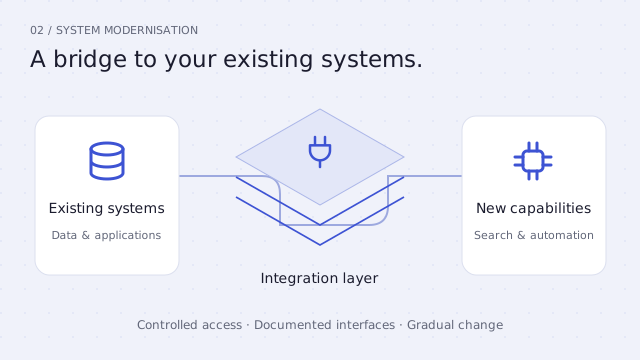
An existing application may still support the business while creating extra work between teams. Employees might copy records between tools, prepare reports manually or wait for information that another system already holds.
An integration can address some of these problems. Before approving the work, establish what information needs to move, which system owns it and how the connection will be maintained. These decisions matter as much as the connector itself.
Define the process you want to improve
Choose a specific exchange of information and describe its business purpose. For example, an approved customer record might need to move from a sales application into an operations system.
Record the current steps, the people involved and how exceptions are handled. Agree on what should improve: fewer repeated entries, shorter delays or fewer inconsistent records.
Decide which system is authoritative for each important field. Two applications may hold customer details while using them for different purposes. The integration needs a rule for deciding which updates to accept and what to do when values conflict.
Confirm how the systems can exchange data
A supported application programming interface (API) provides a defined way for software to request or update information. Depending on the applications, other options may include scheduled file transfers, events or approved database access.
Ask the technical team to confirm:
- Whether the interface supports the required records and actions
- Authentication, permissions and supplier restrictions
- Limits on request volumes or data exports
- Availability of a suitable test environment
- How interface changes and version support are communicated
Direct database access can bypass application validation or depend on an internal structure that changes later. It should be assessed explicitly, particularly where the integration will write data.
Agree on how current the information needs to be
Not every process requires immediate updates. A daily reporting feed has different requirements from an application that must show a recent stock change before an order is accepted.
State the acceptable delay in business terms. The technical design can then choose an appropriate approach, such as scheduled transfers, requests made when needed or updates triggered by events.
A faster connection does not automatically resolve inconsistent records. The design still needs field mapping, validation and a way to reconcile differences.
Define what happens when a transfer fails
A receiving application can accept an update even if the caller never receives its response. Retrying that request without checking may repeat the action.
Microsoft’s Retry pattern guidance explains why retries must account for whether an operation is idempotent: repeating it has the same intended effect as performing it once. For a record-creation operation, the receiving application needs a reliable way to recognise the same request. A separate check for an existing record is not sufficient when two requests arrive at the same time.
Use the destination’s idempotency support where available. Where the integration manages its own records, duplicate detection and the corresponding data change should be committed together as one indivisible operation, with a uniqueness rule to handle concurrent requests. Calls to external systems need their own duplicate-handling or reconciliation arrangements. Microsoft’s Idempotent Consumer guidance explains these cases.
Retries should be limited and used for suitable temporary failures. Invalid records, expired permissions and unavailable fields need different handling. Repeatedly sending the same invalid request will not fix its data.
Agree on who sees failed transfers, who can correct them and how a corrected record is resubmitted. Technical logs should support investigation without unnecessarily copying confidential information.
Review the implementation and operating costs
The cost is not limited to developing the connection. Include supplier charges, hosting, monitoring, data correction and maintenance when either application changes.
Before approving implementation, ask for a short integration plan:
| Item | What the plan should explain |
|---|---|
| Purpose | The business process and expected improvement |
| Data ownership | Which system controls each important record or field |
| Timing | The acceptable delay and expected transfer volume |
| Exceptions | Validation, duplicate handling and recovery responsibilities |
| Maintenance | Who owns the connection and handles interface changes |
Introduce the connection in stages
Use representative records to compare the new process with the existing one. Check updates, deletions where relevant, access restrictions and failure scenarios, as well as the normal transfer.
Plan how to pause the integration and reconcile records if a problem occurs. Stopping a connector does not undo changes already made to another system.
Integration may be a useful intermediate step, but it cannot resolve every limitation of an older application. Unsupported software, unsuitable interfaces or extensive duplicated business logic may justify replacement. Compare those options before committing to a connection that will be expensive to maintain.
Explore AgentixBrain’s System Modernisation and Custom Software Development services for application changes, backend services and integrations.